What Is Digital Transformation in Government Agencies?
May 18, 2026
Staff Augmentation vs Outsourcing: What’s the Difference?
June 1, 2026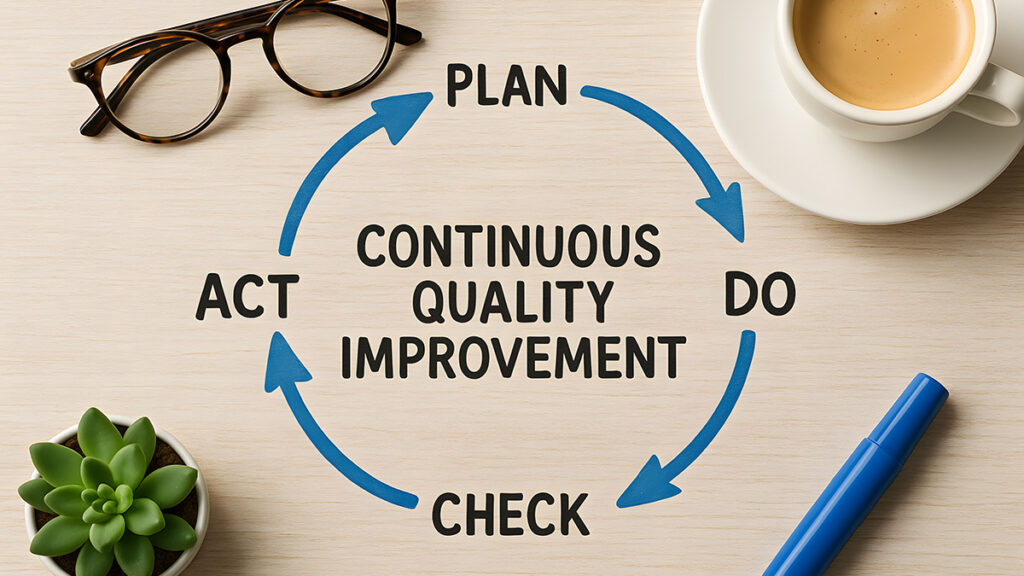
The continuous improvement process is an ongoing effort to improve products, services, workflows, and business operations through small, measurable changes over time. For organizations in the USA, continuous improvement supports better quality management, increased efficiency, stronger customer satisfaction, and more consistent organizational performance.
At its core, continuous improvement is not a one-time project. It is an ongoing process that involves gathering data, identifying problems, testing improvement ideas, and refining the management process until teams reach a desired outcome. Businesses use continuous improvement methodologies to streamline processes, eliminate waste, reduce manual errors, and help employees contribute effectively to long-term operational excellence.
For companies like JuzSolutions, which supports government and commercial clients through technology, staffing, process optimization, and practical business solutions, continuous process improvement is closely tied to better service delivery, smarter data driven decision making, and sustained success.
What Is the Continuous Improvement Process in Modern Business Operations?
The continuous improvement process is a structured approach businesses use to continuously assess, improve, and optimize processes, systems, and outcomes. It focuses on making ongoing improvements instead of waiting for major problems to appear before taking action.
In modern business operations, the improvement process usually includes identifying opportunities, analyzing performance metrics, testing solutions, implementing changes, and tracking progress through key performance indicators. This makes continuous improvement a practical foundation for operational excellence, especially in industries where service quality, compliance, cost control, and customer focus matter.
How does continuous improvement differ from continuous process improvement?
Continuous improvement is the broader business philosophy. It applies to products, services, people, workflows, culture, customer experience, and organizational performance.
Continuous process improvement is more specific. It focuses on improving business processes, standard operating procedures, repetitive tasks, workflow steps, and process efficiency.
The difference is simple:
| Concept | Main Focus | Example |
| Continuous improvement | Overall improvement across the organization | Improving employee engagement, service quality, and customer satisfaction |
| Continuous process improvement | Improving a specific process or workflow | Reducing approval delays, removing duplicate steps, or automating repetitive tasks |
Both concepts work together. Continuous improvement creates the culture, while continuous process improvement gives teams a practical way to improve daily operations.
Why is continuous improvement a critical component of business process optimization?
Business process optimization requires more than one-time fixes. Processes change as teams grow, customer needs shift, technology advances, and regulations evolve. Continuous improvement allows businesses to adjust before small problems become expensive operational issues.
It supports business process optimization by helping organizations:
- Identify improvement opportunities early
- Use data analysis instead of assumptions
- Standardize what works
- Remove steps that create delays
- Reduce waste and manual errors
- Improve service delivery
- Create repeatable results
For JuzSolutions, this type of structured improvement supports clients that need practical commercial solutions, reliable staffing models, technology integration, and better operational control.
What industries rely most on continuous improvement methodologies in the USA?
Continuous improvement methodologies are widely used across industries that depend on efficiency, quality, compliance, and measurable outcomes.
Common industries include:
- Healthcare and correctional healthcare
- Government contracting
- Manufacturing processes
- Technology services
- Logistics and supply chain operations
- Financial services
- Human resources and staffing
- Customer service and call center operations
- Public sector administration
- Professional services
Each industry may use different continuous improvement methods, but the goal remains the same: improve quality, enhance efficiency, and create a significant competitive advantage.
Understanding the meaning of continuous improvement is the first step. The next step is understanding the core principles that make the process work consistently.
What Are the Core Principles of Continuous Improvement?
The core principles of continuous improvement give teams a clear framework for improving work over time. These principles help organizations move from random improvement efforts to a repeatable improvement model that supports better performance.
Continuous improvement succeeds when leadership, employees, data, and processes are aligned. The following principles explain how organizations can build improvement initiatives that are practical, measurable, and sustainable.
Focus on incremental improvement over time
Incremental improvement means making small, steady changes that improve performance without disrupting the entire organization. These incremental changes may look simple, but they create meaningful results when repeated over time.
Examples include:
- Shortening response times
- Reducing form errors
- Improving handoff steps between departments
- Updating standard operating procedures
- Automating repetitive tasks
- Clarifying employee responsibilities
Incremental improvement is useful because it lowers risk. Teams can test improvements, measure the results, and adjust before scaling changes across the organization.
Prioritize data driven decision making
Data driven decision making helps teams understand what is actually happening inside a process. Instead of guessing, businesses use data analytics, performance metrics, and key performance indicators to make better decisions.
Useful data may include:
- Cycle time
- Error rates
- Customer complaints
- Employee feedback
- Cost per task
- Completion time
- Service delivery delays
- Quality scores
- Productivity trends
This approach allows organizations to identify improvement opportunities with evidence, not opinion.
Encourage employee involvement at all levels
Employee involvement is one of the strongest drivers of successful continuous improvement. Employees who perform the work every day often understand process gaps better than leadership teams do.
When employees actively participate, they can:
- Share improvement ideas
- Explain where delays happen
- Identify manual errors
- Suggest better workflows
- Support practical implementation
- Improve team ownership
Involving employees also improves employee engagement because people feel their ideas matter.
Identify improvement opportunities continuously
Continuous improvement depends on constantly identifying opportunities for better results. These opportunities may come from data analysis, customer feedback, employee suggestions, audits, compliance reviews, or process mapping.
Common improvement opportunities include:
- Unnecessary approvals
- Duplicate work
- Missed communication
- Poor documentation
- Slow response times
- Repeated customer complaints
- Low-quality outputs
- Manual tasks that can be automated
The goal is not to criticize the current process. The goal is to find where the organization can perform better.
Standardize and refine business processes
Standardization helps teams produce consistent results. Once a better way of working is identified, it should be documented and turned into a repeatable process.
Standard operating procedures are especially important in regulated industries, government work, healthcare support, and service delivery environments. They help teams reduce confusion, train employees faster, and maintain improved quality.
Align improvement initiatives with business goals
Improvement initiatives should connect to real business priorities. If an improvement effort does not support customer satisfaction, cost savings, compliance, service quality, employee productivity, or organizational performance, it may not be worth the investment.
Strong improvement initiatives usually connect to goals such as:
- Enhance efficiency
- Reduce waste
- Improve customer focus
- Strengthen quality management
- Increase employee engagement
- Improve delivery timelines
- Support sustained success
This alignment keeps continuous improvement practical and measurable.
Foster a culture of accountability and ownership
Continuous improvement works best when teams take ownership of outcomes. Accountability does not mean blaming employees when something goes wrong. It means giving people clear roles, necessary resources, and the authority to improve the work they manage.
A culture of ownership encourages employees to solve problems early, communicate openly, and participate in ongoing improvements.
Measure outcomes using key performance indicators
Key performance indicators help organizations track progress and understand whether improvement efforts are working. Without KPIs, improvement becomes difficult to prove.
Common KPIs include:
- Processing time
- Cost reduction
- Customer satisfaction scores
- Employee productivity
- Defect rates
- Rework percentage
- Compliance accuracy
- Service completion time
- Employee engagement scores
KPIs should be simple, relevant, and tied to the desired outcome.
Sustain improvements through continuous monitoring
Improvement does not end after implementation. Teams must continuously assess results to make sure the new process keeps working.
Continuous monitoring helps businesses:
- Catch performance drops early
- Adjust workflows when conditions change
- Maintain quality standards
- Prevent old habits from returning
- Support continuous learning
These core principles create the foundation. Once the principles are clear, it becomes easier to see why continuous improvement is important for long-term business growth and operational efficiency.
Why Is Continuous Improvement Important for Business Growth and Operational Efficiency?
Continuous improvement is important because it helps organizations improve performance without waiting for major failures. It gives leaders and teams a practical way to enhance efficiency, improve quality, reduce waste, and make better decisions over time.
For growing businesses, continuous improvement creates structure. For established organizations, it prevents stagnation. For government and commercial clients, it supports accountability, consistency, and measurable results.
How does continuous improvement enhance efficiency across departments?
Continuous improvement enhances efficiency by helping teams remove unnecessary steps, clarify responsibilities, and use resources more effectively. When departments operate with clearer workflows, work moves faster and with fewer errors.
For example, a staffing or operations team may improve efficiency by:
- Standardizing intake forms
- Reducing duplicate data entry
- Improving communication between departments
- Using automation for repetitive tasks
- Tracking bottlenecks with performance metrics
- Creating clearer escalation procedures
These improvements may seem small, but they reduce delays across the entire organization.
What role does continuous improvement play in reducing operational waste?
Waste is any activity that uses time, money, labor, or materials without adding value. Continuous improvement helps organizations eliminate waste by revealing where resources are being misused.
Common types of waste include:
- Waiting time
- Overprocessing
- Duplicate work
- Rework caused by errors
- Poor communication
- Unnecessary movement of information
- Underused employee skills
- Manual work that can be automated
By reducing waste, organizations improve productivity and create more value for customers, employees, and stakeholders.
How does it support long-term scalability and adaptability?
Scalability requires repeatable systems. If a business grows without improving its processes, small inefficiencies become larger problems.
Continuous improvement supports scalability by helping organizations:
- Create reliable workflows
- Improve training processes
- Standardize service delivery
- Use technology effectively
- Build cross functional teams
- Strengthen problem solving
- Adapt to market or regulatory changes
This is especially valuable for organizations that serve multiple clients, operate in complex industries, or need to meet strict performance expectations.
The importance of continuous improvement becomes even clearer when we look at the methodologies organizations use to put these principles into action.
What Are the Most Effective Continuous Improvement Methodologies Used Today?
Continuous improvement methodologies give organizations structured ways to solve problems, improve processes, and measure results. Different methodologies are used depending on the organization’s goals, industry, timeline, and complexity.
The most widely used tools and methods include Lean, Six Sigma, Kaizen, Agile, and Total Quality Management. Each method supports continuous improvement, but each one approaches improvement from a different angle.
What is Lean methodology in continuous improvement?
Lean methodology focuses on eliminating waste and creating more value with fewer resources. It is commonly used in manufacturing processes, healthcare, logistics, government operations, and service-based businesses.
Lean helps organizations identify activities that do not add value and remove them from the workflow.
Common Lean goals include:
- Reduce waste
- Improve flow
- Shorten cycle time
- Improve quality
- Simplify processes
- Increase customer value
Lean is useful when an organization wants to streamline processes and improve efficiency without adding unnecessary complexity.
How does Six Sigma improve process quality?
Six Sigma focuses on reducing variation and defects in a process. It uses data analysis to find the root causes of problems and improve process consistency.
Six Sigma is especially helpful when quality, accuracy, and compliance are important. It is often used in healthcare, manufacturing, finance, and operational environments where errors can be costly.
Six Sigma supports continuous improvement by helping teams:
- Measure defects
- Identify root causes
- Reduce process variation
- Improve predictable outcomes
- Support quality management
- Strengthen customer satisfaction
What is Kaizen and how does it drive continuous improvement?
Kaizen is a continuous improvement model based on small, ongoing improvements made by everyone in the organization. The word is often associated with gradual positive change.
Kaizen encourages employees to share improvement ideas, solve problems, and improve their daily work. It works well because it does not depend only on leadership. It involves employees at every level.
Kaizen supports:
- Employee involvement
- Continuous learning
- Small process changes
- Team-based problem solving
- Better workplace culture
- Ongoing improvements
How does Agile support continuous process improvement?
Agile methodology is commonly associated with software development and agile project management, but its principles can support many business operations. Agile focuses on short work cycles, feedback, adaptability, and continuous delivery.
Agile supports continuous process improvement by helping teams:
- Test solutions quickly
- Use continuous feedback
- Adjust priorities based on new information
- Collaborate across functions
- Deliver improvements faster
- Reduce long planning delays
Agile is valuable for organizations that need flexibility, faster implementation, and regular feedback loops.
When should businesses combine multiple improvement methodologies?
Businesses should combine improvement methodologies when one method alone does not address the full problem. For example, Lean can reduce waste, Six Sigma can improve quality, and Agile can help teams implement changes faster.
A combined approach may be useful when an organization needs to:
- Improve quality and speed
- Reduce waste and errors
- Modernize service delivery
- Support digital transformation
- Improve employee engagement
- Make better use of data analytics
JuzSolutions’ practical approach to technology, staffing, and process improvement aligns well with this blended model because many operational problems require more than one solution.
Methodologies provide the structure, but data determines where improvement should happen and whether it is working.
How Does Data Driven Decision Making Support Continuous Improvement?
Data driven decision making supports continuous improvement by helping teams make choices based on facts, patterns, and measurable outcomes. It reduces guesswork and gives organizations a clearer view of performance.
When businesses use data correctly, they can identify improvement opportunities, measure the success of improvement initiatives, and make stronger decisions about resources, staffing, technology, and service delivery.
What types of data are used in continuous improvement processes?
Continuous improvement uses different types of data depending on the process being reviewed.
Common data types include:
| Data Type | What It Shows |
| Operational data | How work moves through a process |
| Customer data | Satisfaction, complaints, feedback, and retention |
| Employee data | Engagement, productivity, workload, and feedback |
| Financial data | Cost savings, waste, and budget impact |
| Quality data | Errors, defects, compliance issues, and rework |
| Time data | Cycle time, wait time, and delivery speed |
This data gives teams a practical foundation for problem solving and improvement planning.
How do analytics tools help identify improvement opportunities?
Analytics tools help organizations turn raw data into useful insight. Instead of reviewing scattered reports, leaders can use dashboards, workflow systems, and data analytics platforms to see trends more clearly.
Analytics can show:
- Where bottlenecks occur
- Which tasks take too long
- Which errors happen repeatedly
- Which teams need support
- Which services create the most delays
- Which processes need automation
- Which improvement efforts are working
Advanced tools, including machine learning, can also help detect patterns that may not be obvious through manual review.
What KPIs are essential for tracking improvement initiatives?
The best KPIs depend on the goal of the improvement initiative. A cost-reduction project needs different metrics than a customer satisfaction project.
Useful KPIs include:
- Process completion time
- Cost per transaction
- First-time accuracy rate
- Customer satisfaction score
- Employee engagement score
- Error reduction percentage
- Rework rate
- Service delivery time
- Automation adoption rate
- Compliance accuracy
KPIs should be easy to understand, regularly reviewed, and connected to the desired outcome.
Once organizations know how to use data, they can more effectively identify where improvement opportunities exist.
How Can Businesses Identify Improvement Opportunities Effectively?
Businesses identify improvement opportunities by studying current processes, listening to employees and customers, reviewing performance data, and looking for gaps between current outcomes and desired outcomes.
This step is important because continuous improvement fails when teams solve the wrong problem. A strong discovery process helps organizations focus on the areas that create the highest operational impact.
What techniques help uncover inefficiencies in current processes?
Several techniques can reveal inefficiencies in business operations.
Useful techniques include:
- Process audits
- Employee interviews
- Workflow observation
- Customer feedback review
- Data analysis
- Root cause analysis
- KPI review
- Technology assessment
- Compliance review
- Time tracking
These techniques help teams find the real causes of delays, errors, and waste.
How does process mapping support continuous process improvement?
Process mapping is the practice of visually outlining each step in a workflow. It helps teams see how work actually happens from start to finish.
A process map can reveal:
- Duplicate steps
- Unclear handoffs
- Approval delays
- Manual errors
- Unnecessary tasks
- Missing documentation
- Communication gaps
- Automation opportunities
Process mapping is especially useful for cross functional teams because it gives everyone a shared view of the process.
What role does customer feedback play in identifying gaps?
Customer feedback helps organizations understand whether internal processes are producing the right external results. A process may look efficient internally but still create frustration for customers.
Customer feedback can reveal issues such as:
- Slow response times
- Confusing communication
- Inconsistent service quality
- Poor follow-up
- Repeated mistakes
- Gaps in expectations
Customer focus keeps continuous improvement connected to real-world outcomes.
After identifying opportunities, organizations need employee involvement and employee engagement to make improvements successful in daily operations.
What Is the Role of Employee Involvement and Employee Engagement in Continuous Improvement?
Employee involvement and employee engagement are essential because continuous improvement depends on the people who perform, manage, and improve the work. Employees often know where processes fail, where customers struggle, and where systems create unnecessary friction.
When employees are invited to actively participate, improvement becomes part of the workplace culture instead of a leadership-only initiative.
Why is employee involvement critical for successful improvement initiatives?
Employee involvement is critical because employees see process problems in real time. They understand which tasks are repetitive, which systems create delays, and which procedures need clarification.
Employees can help organizations:
- Find practical improvement opportunities
- Reduce manual errors
- Improve standard operating procedures
- Test new workflows
- Share improvement ideas
- Support adoption across teams
Without employee involvement, improvement initiatives may look good on paper but fail during implementation.
How does employee engagement impact process innovation?
Employee engagement increases process innovation because engaged employees are more likely to speak up, solve problems, and contribute effectively.
When employees feel heard, they are more likely to:
- Suggest better methods
- Support continuous learning
- Participate in team problem solving
- Accept process changes
- Help train others
- Take ownership of outcomes
Higher engagement also reduces resistance to change.
What strategies increase participation in continuous improvement programs?
Organizations can increase participation by making improvement simple, visible, and rewarding.
Effective strategies include:
- Create easy ways to submit improvement ideas
- Recognize employee contributions
- Train employees on improvement methods
- Share results from improvement efforts
- Give teams necessary resources
- Encourage cross functional teams
- Provide leadership support
- Make improvement part of regular meetings
Employee participation turns continuous improvement from a management process into a shared business habit.
When people, processes, and data work together, organizations can realize the full benefits of continuous improvement.
What Are the Key Benefits of Continuous Improvement for Organizations?
The benefits of continuous improvement include better efficiency, improved quality, stronger employee engagement, higher customer satisfaction, and greater long-term competitiveness. These benefits build over time as organizations continue improving their processes and decision-making systems.
Continuous improvement works best when benefits are measured and connected to business goals. This helps leaders understand the return on improvement efforts.
Improved operational efficiency and cost reduction
Continuous improvement helps organizations reduce delays, remove unnecessary steps, and use resources more effectively. This leads to increased efficiency and lower operational costs.
Cost reduction may come from:
- Fewer manual errors
- Less rework
- Faster task completion
- Better staffing alignment
- Reduced waste
- Improved automation
- More consistent workflows
Enhanced product and service quality
Improved quality is one of the most important benefits of continuous improvement. Better processes usually produce better products, services, or processes.
Quality improves when organizations:
- Standardize work
- Reduce variation
- Use data analysis
- Improve training
- Track performance metrics
- Address root causes
- Monitor outcomes
This creates more reliable service quality and stronger customer trust.
Increased employee engagement and satisfaction
Continuous improvement gives employees a voice in how work is done. When employees can share improvement ideas and see those ideas implemented, engagement improves.
This can lead to:
- Higher morale
- Better teamwork
- Stronger ownership
- Lower frustration
- Better problem solving
- More continuous learning
Employee engagement is not just a culture benefit. It directly affects process performance.
Better customer experience and retention
Customers benefit when businesses improve response times, reduce mistakes, and deliver consistent service. Continuous improvement supports customer satisfaction by improving the systems behind the customer experience.
Examples include:
- Faster service delivery
- Clearer communication
- Fewer errors
- More consistent outcomes
- Better follow-up
- Higher service quality
Satisfied customers are more likely to stay, refer others, and trust the organization.
Stronger competitive advantage in the market
Continuous improvement can create a significant competitive advantage because it helps organizations adapt faster and perform better over time.
Companies that continuously improve are often better at:
- Responding to market changes
- Using technology effectively
- Reducing costs
- Improving customer experience
- Maintaining quality
- Scaling operations
This competitive advantage becomes stronger when improvement is embedded into the organization’s culture.
Faster adaptation to market changes
Markets change quickly. Customer expectations, technology, regulations, and workforce needs continue to evolve. Continuous improvement helps businesses adapt without waiting for major disruption.
Organizations can respond faster because they already have systems for feedback, measurement, and change.
Sustainable long-term business growth
Continuous improvement supports sustained success because it improves the organization’s ability to learn, adjust, and grow. Instead of relying on one major transformation, the business improves consistently over time.
These benefits become easier to understand when viewed through real-world continuous improvement examples across different industries.
What Are Real-World Continuous Improvement Examples Across Industries?
Continuous improvement examples show how the same principles can apply across different industries. While the tools may change, the purpose remains consistent: improve quality, reduce waste, enhance efficiency, and create better outcomes.
These examples help connect the concept to practical business operations.
Continuous improvement examples in healthcare operations
In healthcare operations, continuous improvement may focus on patient flow, staffing, documentation, compliance, safety, or service delivery.
Examples include:
- Reducing appointment wait times
- Improving patient intake forms
- Standardizing documentation
- Reducing medication errors
- Improving staff scheduling
- Tracking quality metrics
- Improving communication between departments
For organizations supporting correctional healthcare or government healthcare environments, continuous improvement can improve compliance, staffing efficiency, and care coordination.
Continuous improvement examples in manufacturing processes
Manufacturing processes often use Lean, Six Sigma, Kaizen, and total quality management.
Examples include:
- Reducing production defects
- Improving equipment maintenance
- Eliminating waste in assembly lines
- Standardizing quality checks
- Reducing downtime
- Improving inventory flow
- Automating repetitive tasks
Manufacturing is one of the clearest examples of how incremental and breakthrough improvements can work together.
Continuous improvement examples in government and public sector
Government and public sector organizations use continuous improvement to improve service delivery, reduce delays, and make better use of taxpayer-funded resources.
Examples include:
- Streamlining permit approvals
- Improving citizen response times
- Reducing paperwork duplication
- Improving contract management workflows
- Standardizing reporting procedures
- Using dashboards to track progress
JuzSolutions’ experience with government and commercial clients makes this especially relevant because public sector operations often require both efficiency and accountability.
Continuous improvement examples in technology and service industries
Technology and service industries use continuous improvement to improve user experience, project delivery, support workflows, and internal operations.
Examples include:
- Improving help desk response times
- Reducing software deployment errors
- Refining agile project management workflows
- Automating repetitive support tasks
- Using data analytics to improve service quality
- Improving customer onboarding
These examples show that continuous improvement is practical across many settings. The next step is understanding how to implement the process.
How Do You Implement a Continuous Improvement Process Step by Step?
Implementing a continuous improvement process requires structure, leadership support, employee involvement, and reliable measurement. The goal is to create a repeatable system for identifying problems, testing solutions, and sustaining results.
A common approach is the plan do check act cycle, a four step iterative process used to plan improvements, test changes, review outcomes, and act based on results.
Define objectives and align improvement initiatives
Start by defining the problem and the desired outcome. The improvement initiative should support a clear business goal.
Examples of objectives include:
- Reduce processing time by 20%
- Improve customer satisfaction scores
- Reduce manual errors
- Improve employee engagement
- Enhance efficiency in service delivery
- Reduce waste in a specific workflow
Clear goals help teams stay focused.
Analyze current processes and identify inefficiencies
Next, review the current process. Use process mapping, data analysis, employee feedback, and performance metrics to understand where problems occur.
Ask questions such as:
- Where are delays happening?
- Which steps add no value?
- Where do errors repeat?
- Which tasks are manual and repetitive?
- Which teams are affected?
- What data supports the issue?
This step prevents teams from solving symptoms instead of root causes.
Develop and test improvement strategies
Once the problem is clear, develop possible solutions. Start small when possible. Testing a solution before full rollout reduces risk.
Improvement strategies may include:
- Updating procedures
- Training employees
- Automating tasks
- Removing unnecessary approvals
- Changing team responsibilities
- Introducing new tools
- Improving communication channels
The best strategy is one that is practical, measurable, and aligned with the desired outcome.
Implement changes across business operations
After testing, implement the improved process. Successful implementation requires communication, training, documentation, and leadership support.
Teams should know:
- What is changing
- Why it is changing
- Who is responsible
- How success will be measured
- Where to ask questions
- How feedback will be collected
This makes adoption smoother and reduces resistance.
Monitor results and refine continuously
After implementation, monitor results using KPIs and feedback. If the change works, standardize it. If it does not, adjust the strategy and test again.
This is where continuous improvement becomes an ongoing process rather than a one-time project.
Even with a strong implementation plan, organizations may face challenges that need to be addressed early.
What Challenges Do Organizations Face in Continuous Process Improvement?
Continuous process improvement can produce strong results, but it also requires planning, communication, and consistency. Many organizations struggle because improvement efforts are launched without the right support systems.
Understanding common challenges helps leaders prevent failure and keep improvement initiatives moving forward.
Resistance to change within teams
Resistance to change is common when employees do not understand why a process is changing or how it affects them.
Resistance can be reduced by:
- Explaining the purpose clearly
- Involving employees early
- Providing training
- Showing the benefits
- Listening to concerns
- Sharing progress updates
Change becomes easier when employees feel included.
Lack of clear data and performance metrics
Without clear data, teams cannot identify problems accurately or measure results. This can cause improvement efforts to become subjective.
Organizations need reliable metrics before making major process changes. Data should be accurate, accessible, and tied to the business goal.
Poor alignment between strategy and execution
Some organizations create strong improvement plans but fail during execution. This happens when responsibilities are unclear, resources are missing, or leadership does not stay involved.
Strong execution requires:
- Defined ownership
- Realistic timelines
- Necessary resources
- Clear communication
- Regular progress reviews
- Accountability
Inconsistent leadership support
Leadership support is essential. If leaders do not reinforce continuous improvement, teams may treat it as a temporary project.
Leaders should model continuous learning, recognize improvement efforts, and connect improvement work to business priorities.
These challenges also show why continuous improvement should be compared with other process optimization strategies before choosing the right approach.
How Does Continuous Improvement Compare to Other Process Optimization Strategies?
Continuous improvement is one approach within the larger field of process optimization. It is useful for ongoing improvements, but some business situations may require other strategies such as business process reengineering or automation.
Understanding the difference helps organizations choose the right method for the problem.
Continuous improvement vs business process reengineering (BPR)
Continuous improvement focuses on small, steady improvements over time. Business process reengineering focuses on major redesigns of existing processes.
| Strategy | Best For | Change Level |
| Continuous improvement | Ongoing refinements and steady optimization | Gradual |
| Business process reengineering | Major process redesign or transformation | High |
A company may use continuous improvement when a process works but needs refinement. It may use BPR when the process is outdated or no longer effective.
Continuous improvement vs process automation
Process automation uses technology to complete tasks with less manual effort. Continuous improvement may include automation, but automation is not the entire process.
Automation is useful for:
- Repetitive tasks
- Data entry
- Notifications
- Reporting
- Workflow routing
- Reducing manual errors
However, automating a broken process can make problems happen faster. Continuous improvement helps determine whether a process should be improved before automation.
Which strategy is best for long-term efficiency?
For long-term efficiency, continuous improvement is often the strongest foundation because it creates a culture of ongoing review and refinement. However, the best results often come from combining continuous improvement with automation, data analytics, and strategic process redesign.
JuzSolutions’ practical commercial solutions fit this blended approach because many organizations need people, process, and technology improvements working together.
The right tools and technologies make this work easier to manage and scale.
What Tools and Technologies Support Continuous Improvement Initiatives?
Tools and technologies help organizations collect data, manage improvement initiatives, track performance, and improve collaboration. While continuous improvement depends on people and process discipline, technology can make improvement faster and more visible.
The right tools depend on the organization’s size, industry, goals, and workflow complexity.
Process mapping and workflow tools
Process mapping tools help teams visualize workflows and identify gaps. Workflow tools help manage tasks, approvals, and handoffs.
They support continuous improvement by showing:
- Where work slows down
- Which steps are duplicated
- Who owns each task
- Where automation may help
- Where documentation is missing
Data analytics and performance tracking platforms
Data analytics platforms help teams monitor KPIs and track progress. Dashboards make it easier for leaders to see whether improvement efforts are working.
These tools support:
- Faster decision making
- Better visibility
- Trend detection
- Performance comparison
- More accurate reporting
- Continuous feedback loops
Automation and AI-driven solutions
Automation and AI-driven solutions can reduce manual work, improve consistency, and support faster service delivery.
Examples include:
- Automated reporting
- Workflow reminders
- Data validation
- Document routing
- Chat support
- Machine learning for pattern detection
- Automated quality checks
These tools are most effective when aligned with a clear improvement strategy.
Collaboration tools for employee engagement
Collaboration tools help teams communicate, share improvement ideas, and work across departments.
They are useful for:
- Cross functional teams
- Project management
- Feedback collection
- Training updates
- Documentation sharing
- Team accountability
Technology supports continuous improvement, but digital transformation makes it even more important for modern USA-based organizations.
How Does Continuous Improvement Align with Digital Transformation in the USA?
Continuous improvement aligns with digital transformation because both focus on making organizations more efficient, adaptive, and data-informed. Digital transformation introduces new tools, while continuous improvement ensures those tools solve the right problems.
In the USA, organizations across government, healthcare, staffing, technology, and commercial services use digital transformation to improve service delivery, reduce manual work, and strengthen operational control.
Role of continuous improvement in modern enterprise systems
Modern enterprise systems generate large amounts of operational data. Continuous improvement helps organizations use that data to improve workflows, quality, and performance.
Without continuous improvement, digital systems may become expensive tools that do not create meaningful change. With continuous improvement, systems become part of a larger strategy for operational excellence.
Integration with AI, automation, and cloud technologies
AI, automation, and cloud technologies support continuous improvement by making information easier to access and act on.
They can help organizations:
- Reduce repetitive tasks
- Improve reporting accuracy
- Detect process issues
- Support remote collaboration
- Improve customer service
- Track performance in real time
- Scale operations faster
The key is to connect technology with clear process goals.
How companies like JuzSolutions support process optimization
JuzSolutions supports organizations by helping them improve operations through technology, staffing, and practical business solutions. This type of support is valuable because continuous improvement often requires more than advice.
Organizations may need:
- Process analysis
- Skilled staffing support
- Technology integration
- Workflow improvement
- Project management
- Data-driven operational support
- Scalable service delivery models
By combining process expertise with practical implementation, JuzSolutions helps clients move from improvement ideas to measurable business outcomes.
Now that the main concepts, methods, benefits, and tools are clear, it is useful to answer the most common questions searchers ask about continuous improvement.
What Are the Most Common Questions About Continuous Improvement?
This section provides clear, direct answers to common questions about continuous improvement. These answers are designed to help readers quickly understand the main concepts while reinforcing the article’s broader topic coverage.
What is the continuous improvement process in simple terms?
The continuous improvement process is a structured way to make small, ongoing improvements to products, services, workflows, and business operations. It uses data, employee feedback, process review, and performance tracking to improve results over time.
What are the 4 stages of continuous improvement?
The 4 stages of continuous improvement are plan, do, check, and act. This plan do check act cycle is a four step iterative process used to plan a change, test it, review the results, and make adjustments based on what was learned.
What is an example of continuous improvement?
An example of continuous improvement is a service team reducing response time by reviewing customer complaints, identifying delays, updating standard operating procedures, training employees, and tracking progress through performance metrics.
Why is continuous improvement important for businesses?
Continuous improvement is important because it helps businesses improve quality, reduce waste, enhance efficiency, increase customer satisfaction, and create sustained success. It also helps teams adapt to changing customer needs, technology, and market conditions.
How long does it take to see results from improvement initiatives?
Some improvement initiatives show results within a few weeks, especially when they involve small workflow changes. Larger initiatives involving technology, staffing, training, or process redesign may take several months. The timeline depends on the complexity of the process, the quality of data, leadership support, and employee involvement.
Can small businesses implement continuous improvement methodologies?
Yes, small businesses can implement continuous improvement methodologies. They can start with simple steps such as collecting customer feedback, tracking common errors, improving employee training, documenting workflows, and making incremental changes to daily operations.
Conclusion: How Continuous Improvement Drives Long-Term Business Success
The continuous improvement process helps organizations build better systems, stronger teams, and more reliable outcomes. It gives businesses a practical framework for identifying problems, testing solutions, measuring results, and improving over time.
The key benefits of continuous improvement include increased efficiency, improved quality, stronger employee engagement, better customer satisfaction, reduced waste, and long-term competitive advantage. These results happen when organizations combine data driven decision making, employee involvement, leadership support, and the right improvement methodologies.
For USA-based organizations working in complex commercial, government, healthcare, staffing, or technology environments, continuous improvement is not just an operational tool. It is a long-term business discipline. Companies like JuzSolutions help organizations connect people, processes, and technology so improvement efforts become practical, measurable, and sustainable.
A strong continuous improvement model does not depend on one large transformation. It depends on ongoing improvements, continuous feedback, and a culture where teams actively participate in making work better every day.